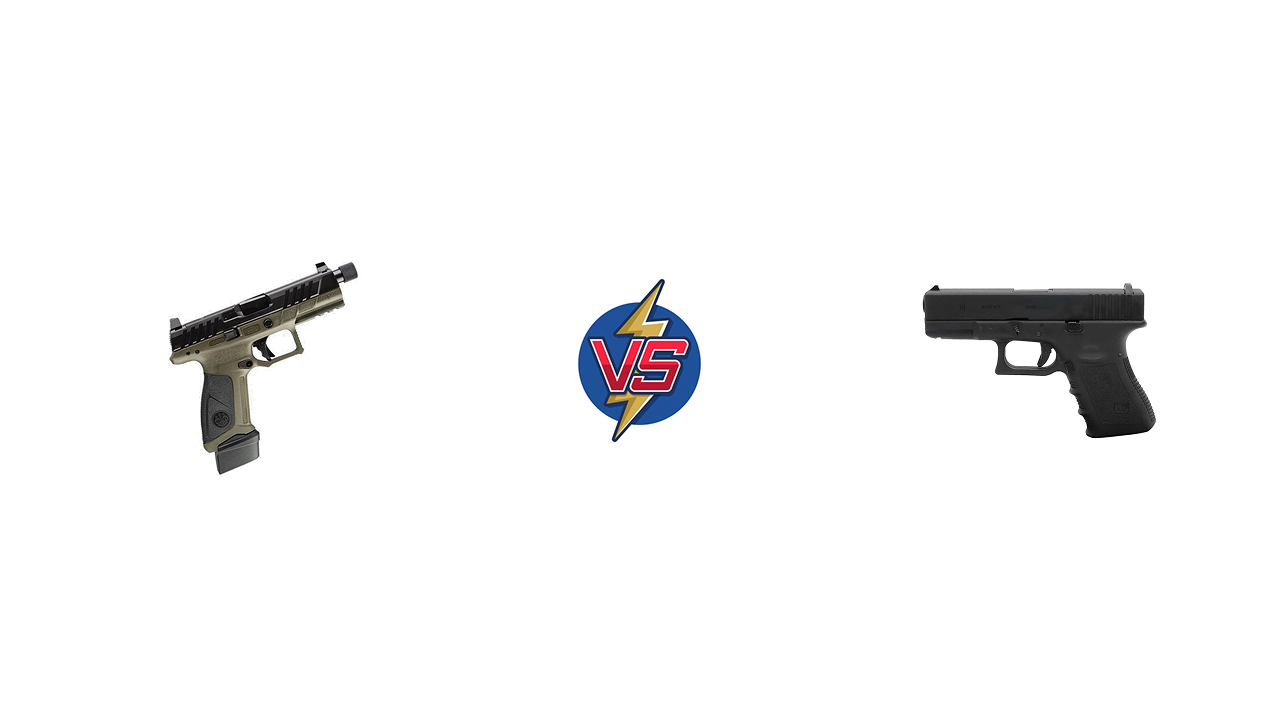
Buying a handgun for personal defense, home defense, or sport shooting is a highly personal decision. The most accurate way to evaluate two guns or brands is to compare the features that matter most to you, your intended use, and objective data such as accuracy, weight, magazine capacity, and price/performance. Today, many modern gun owners prefer 9 mm pistols for self-defense. The reason for this is that 9×19 mm ammunition has a wide range of options across different sizes, weights, and platforms.
This variety makes it even more important to compare the features of similar guns and how they serve your needs. Glock and Beretta are two of the most popular brands in the handgun market. Both have loyal user bases and critics. So, which one is better?
In this article, I will pit the Glock 17 against the Beretta 92 models and examine which gun might be more suitable for which user. Both models are among the proven, iconic, and financially accessible handguns. However, each has unique characteristics that can be “perfect” for the right user and “unsuitable” for the wrong one.
The Origin and Features of the Glock 17
When Gaston Glock began designing the Glock 17 in the 1980s, he was new to gun design. An Austrian engineer, Glock was an expert in advanced synthetic polymers rather than guns. Dissatisfied with the pistols on the market at the time, Glock decided to produce a handgun from scratch that would answer modern needs.
During this process, he formed a team of retired soldiers, police officers, and experts, aiming to respond to the Austrian Armed Forces’ search for a new service pistol to replace the Walther P-38. Glock used a high-strength, nylon-based polymer called Polymer 2, which he developed himself, in the frame and many parts.
This polymer makes Glock pistols highly resistant to extreme temperatures, chemical substances, and harsh environmental conditions. Glock pistols are manufactured in both Austria and the USA. Models produced in the USA are distinguished from Austrian productions only by the “USA” stamp on them.
Beretta’s Deep-Rooted History
Unlike Glock, Beretta is a deeply rooted family company that has been manufacturing arms since 1526. By the 1650s, Beretta had supplied weapons for almost all major wars in Europe. Managed by the same family for nearly 500 years, Beretta is one of the oldest manufacturers in the world still producing the same product.
In the 1980s, Beretta was selected as the US Army’s service pistol under the name M9. This pistol was used for many years by the Army, Marine Corps, Navy, and Air Force. Although the M9 was replaced by another model in 2019, the Beretta 92 series gained a reputation for reliability among military and civilian users.
Beretta’s product range is quite extensive, ranging from revolvers to semi-automatic pistols, and from rifles to submachine guns. Within the scope of the domestic production requirement for the M9s produced for the US army, the Beretta USA factory operates in the state of Maryland.
Glock 17 and Beretta 92 Comparison
The Glock 17 and Beretta 92 are two full-size pistols with double-stack magazines that use 9×19 mm Parabellum ammunition. Both are considered among the best in their class in terms of reliability, accuracy, and price/performance.
Magazine Capacity
- Glock 17: 10+1 capacity
- Beretta 92: 15+1 capacity
Beretta offers higher magazine capacity. However, this advantage also increases the weight of the gun. For those who want a lighter gun or are considering concealed carry, Glock stands out at this point. The Glock 17 is approximately half a kilo lighter than the Beretta 92.
Trigger and Firing System
- Glock 17: Striker-fired, same trigger pull weight on every shot.
- Beretta 92: Double action / single action (DA/SA).
Glock’s trigger structure is consistent, but it is described by some users as “soft” or “spongy.” Trigger modifications are possible but require additional cost.
Beretta’s DA/SA system requires a learning curve. However, it is quite reassuring for users with a military background or those accustomed to this system.
Ergonomics
Ergonomics is one of the most decisive factors in choosing between these two guns.
- Users with small hands generally find the Glock 17 more comfortable.
- The Beretta 92 FS has a wider and thicker grip. This can create a disadvantage for some users in one-handed use.
Glock’s grip is thinner, and its maneuverability is high; it provides an advantage especially in one-handed shooting.
Price, Accuracy, and General Evaluation
In terms of accuracy and general performance, there is no serious difference between the Glock 17 and the Beretta 92. On the price side, Glock is generally slightly more affordable, but aftermarket upgrades can increase the total cost.
In conclusion, the choice depends entirely on your personal needs and comfort. The most correct decision is to try both guns at a range and experience the grip feel, weight balance, and recoil control firsthand. If you are considering concealed carry, size and weight differences can directly affect your decision.
In Summary:
- For those who want a lighter, simpler, and modern design: Glock 17
- For those looking for a classic, high capacity, and DA/SA system: Beretta 92
Both pistols are extremely reliable and successful choices for the right user.