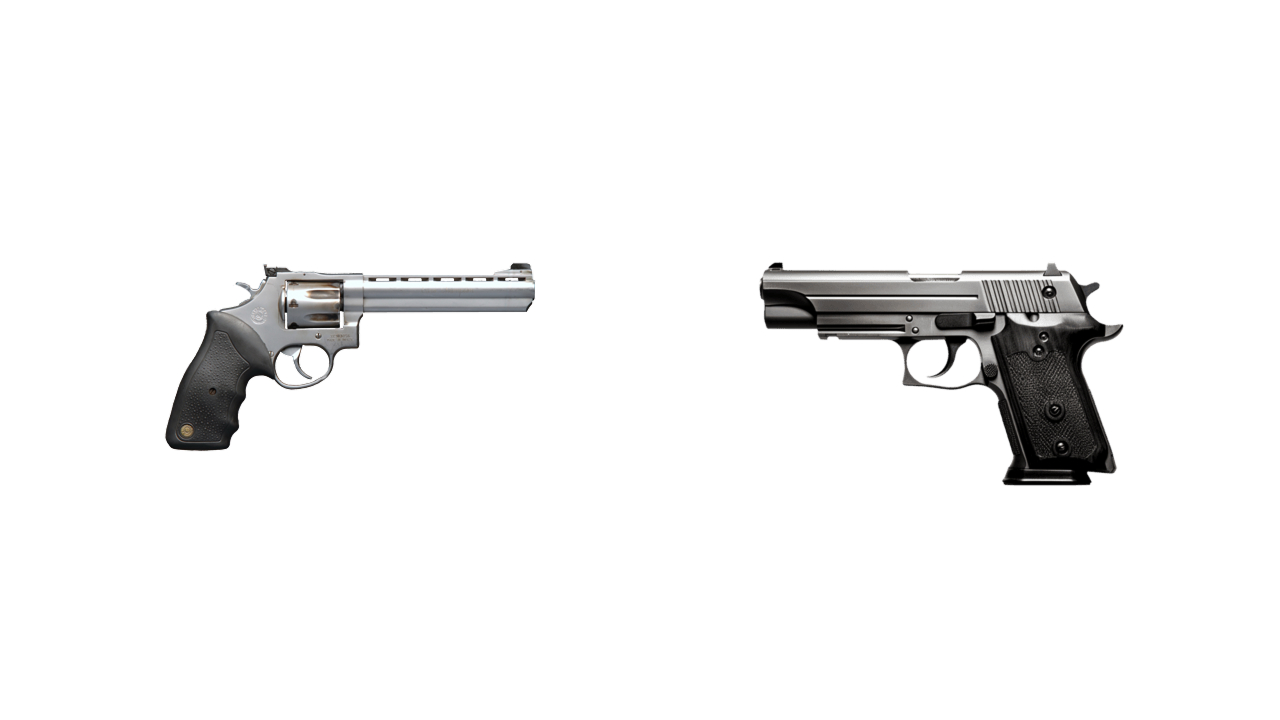
Revolvers and semi-automatic pistols are among the most widely used types of short-barreled firearms today. Both types of weapons trace their origins back to the 19th century. However, the history of revolver-type firearms extends back to the 16th century, undergoing significant technical developments during this period.
Understanding the differences between these two types of weapons can help you make the right choice for purposes such as home defense, concealed carry, or sport shooting.
What is a Revolver?
A revolver is generally a handgun with a single barrel and a rotating cylinder containing multiple chambers. When the trigger is pulled or the hammer is cocked, the mechanism rotates the cylinder one position, and the top chamber (at the 12 o’clock position) aligns with the barrel.
Revolver Operation Types
Single Action Only (SAO)
In this type of revolver, the trigger only releases the hammer. To fire, the hammer must be manually cocked with the thumb. Unloading is done by rotating the cylinder by hand in the half-cock position and removing cartridges one by one with the ejector rod.
Double Action / Single Action (DA/SA)
In these revolvers:
- You can fire by cocking the hammer (single action),
- Or by pulling the trigger directly (double action).
In double action mode, the trigger pull is longer and heavier; in single action mode, it is shorter and more sensitive.
Double Action Only (DAO)
These revolvers do not have a single action option. The hammer is usually concealed or completely enclosed. This structure reduces the risk of snagging on clothing and provides an advantage for concealed carry. The DAO system is particularly common in short-barreled (snub nose) revolvers.
Loading and Unloading in Modern Revolvers
In today’s revolvers:
- The cylinder latch is opened,
- The cylinder swings out to the side,
- The chambers become directly accessible.
Latches operate differently depending on the manufacturer:
- Colt: Latch is pulled back.
- Smith & Wesson / Taurus: Latch is pushed forward.
- Ruger: Latch is pressed in.
What is a Semi-Automatic Pistol?
Semi-automatic pistols are single-barreled firearms fed by a magazine. The biggest difference from revolvers is that the next round is chambered not mechanically, but by the slide utilizing the gas pressure or recoil force generated after firing.
In pistols, the chambers are fixed; there is no rotating cylinder.
Working Principle of Semi-Automatic Pistols
Pistols can be hammer-fired or striker-fired.
Most modern defense pistols use a short recoil system.
The slide moves back after firing, ejects the empty case, and drives a new cartridge into the chamber.
Difference Between Magazine and Clip
A magazine is a mechanism that feeds cartridges into the firearm via spring pressure. A clip is used only to quickly load cartridges into a magazine and does not contain a spring.
In summary:
Clips feed magazines, magazines feed the gun.
In revolvers:
- Half-moon and full-moon clips can be used.
- Especially with rimless cartridges like 9 mm or .45 ACP, the clip ensures the extractor star can grip the cartridges.
Revolver and Pistol Comparison
Reliability
Because revolvers are not dependent on ammunition power:
- Low-pressure target loads,
- High-power defense loads can be cycled without issues.
In pistols, the feed ramp and slide movement play a critical role.
Malfunction Status
A jam in a pistol usually requires racking the slide. In a revolver, pulling the trigger again is sufficient.
Contact Shot
In semi-automatic pistols, if the muzzle is pressed against a surface, the slide may be pushed out of battery, rendering the gun unable to fire. Since revolvers have a fixed barrel, this risk does not exist.
Accuracy and Control
Thanks to the fixed barrel, revolvers:
- Naturally offer more consistent accuracy.
- Better control recoil due to a heavier frame.
Capacity Comparison
- Revolvers: Usually 5–7 rounds.
- Semi-automatic pistols:
- Sub-compact models: 6 rounds
- Large-frame pistols: 20+ rounds
Therefore, pistols have a clear advantage in terms of capacity.
Reloading Speed
An experienced shooter can reload a revolver quickly; however:
- Aligning the Speedloader,
- Closing the mechanism requires more manual dexterity.
In pistols, magazine changes are more practical.
Best Pistols for Home Defense
Ultra-compact weapons are not a necessity for home defense. Larger and heavier pistols offer:
- Better control,
- Higher magazine capacity.
Prominent models:
- Glock 17
- Glock 19
- HK VP9
- FN 509
These pistols are known for their durability, ergonomics, and reliability.
Best Revolvers for Home Defense
Short-barreled revolvers preferred for concealed carry:
- Offer less control,
- Produce more recoil.
Ideal choice for home defense:
- Full-size revolvers with a 4–6 inch barrel.
Prominent model:
- Ruger GP100
- .357 Magnum
- 6 or 7 round capacity
- 40–45 oz weight
- High durability and recoil control
Common Revolver Calibers
- .38 Special
- .357 Magnum
- .44 Special
- .44 Magnum
- .45 Colt
Common Pistol Calibers
- .380 ACP
- 9 mm
- .40 S&W
- .45 ACP
Conclusion
Choosing the right weapon for home defense, concealed carry, or sporting use can be difficult. However, knowing the differences between a revolver and a semi-automatic pistol allows you to make the choice that best suits your needs.
Both types of weapons have their strong and weak points; what matters is the intended use, level of control, and personal preferences.