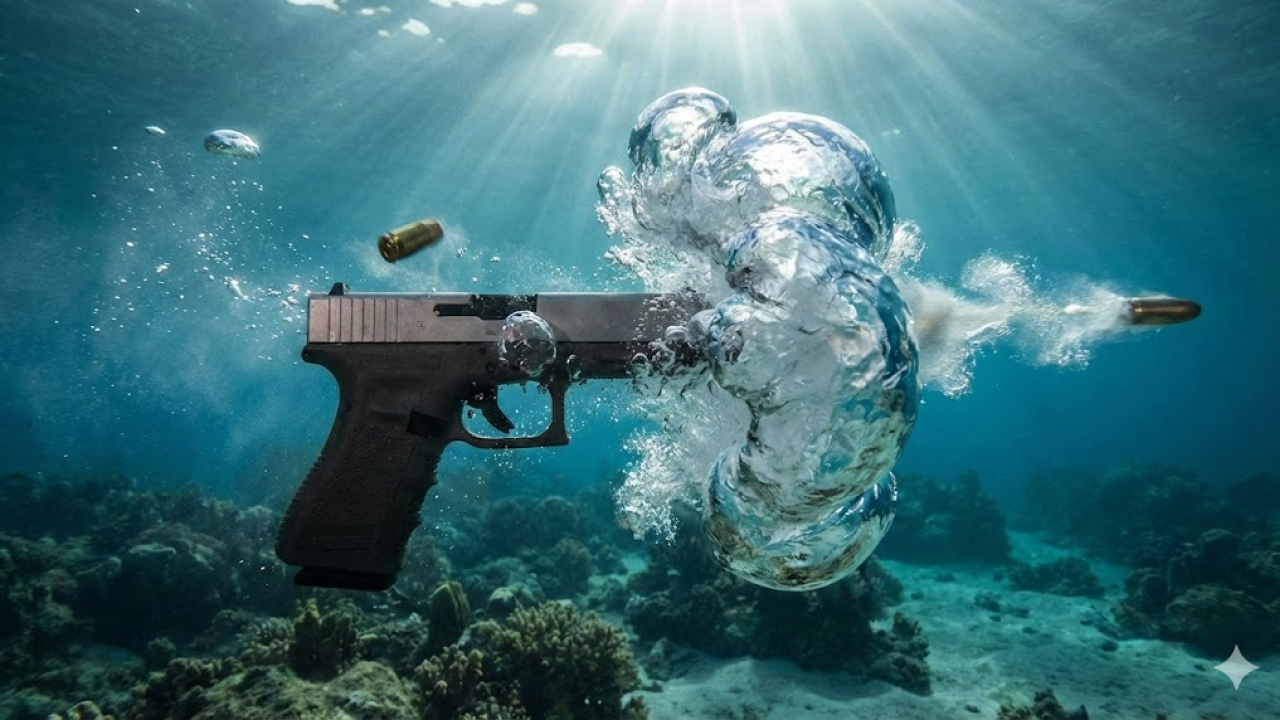
To answer briefly: Yes, a gun can fire underwater. However, this does not mean that guns are effective or reliable underwater. Firearms exhibit very limited performance underwater and in most cases do not yield the expected result.
Why Does Gunpowder Ignite Underwater?
Gunpowder contains the oxygen necessary for combustion within its own structure. Therefore, when the trigger is pulled, if water has not entered the cartridge, the gun fires underwater as well. Mechanically, the operation of the gun starts the same way as it does on land.
What Happens When the Bullet Enters the Water?
Water is approximately 800% denser than air. This density difference changes the bullet’s behavior dramatically. A bullet moving at high speed in the air slows down rapidly the moment it makes contact with water.
In a scientific experiment, a physicist stood in a pool and tested a bullet fired underwater directly at himself. The result is clear:
The bullet loses its energy immediately after entering the water, cannot advance, and sinks to the bottom of the pool in a short time.
How Does Water Affect the Bullet and Mechanism?
Underwater conditions bring many problems for firearms:
Effect on Ammunition
Modern ammunition is largely water-resistant.
Rain and short-term exposure to water usually do not cause problems.
If a cartridge remains underwater for a few minutes, it can mostly still fire.
However, water may seep into ammunition left underwater for hours or longer. In this case, the gunpowder gets wet and ignition does not occur.
Mechanism Issues in Semi-Automatic Weapons
Guns are designed for standard atmospheric conditions. Underwater:
The empty casing may not be ejected properly
“Stovepipe” (jamming of the casing) may occur
The slide cannot move fast enough
This causes semi-automatic pistols and rifles to generally become single-shot weapons underwater.
The Revolver and AK-47 Exception
Revolvers do not experience these types of feeding and ejection issues because they do not have a semi-automatic mechanism. Additionally, in some tests, findings suggest that the AK-47 is able to fire repeatedly underwater.
Why is the Range So Short Underwater?
When a gun is fired underwater, the barrel instantly fills with water. The bullet has to push this water to exit the barrel. The weight of this water can be heavier than the bullet itself in some cases.
Consequently:
Muzzle velocity drops significantly
The bullet rapidly loses energy in the water
Ballistic stability is disrupted
Effective range is limited to approximately 1.5 – 2 meters (5–6 feet) for most guns. Beyond this distance, the bullet quickly becomes ineffective and loses its lethality.
Is It Dangerous If the Bullet Exits the Water?
Even if the bullet exits the water shortly after leaving the barrel, it has already lost significant speed, its balance is disrupted, and its ballistic performance has dropped drastically. Therefore, even after exiting the water, its impact cannot be compared to a shot fired on land.