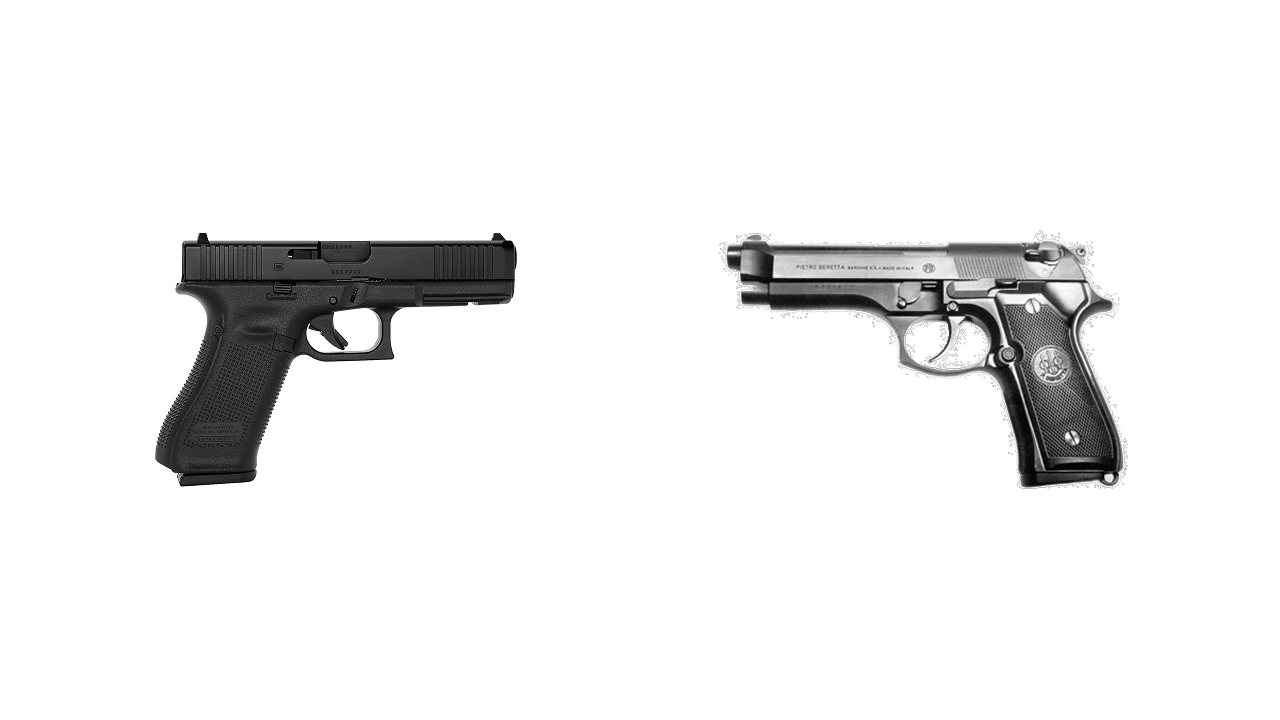
n recent years, the models I have used the most have been the Glock and the Beretta 92 series. Both are among the most popular pistols ever produced.
In this article, I will touch upon the basic differences between Glock and Beretta and share my own experiences. However, this is not an “endurance test” or a comparison article under extreme conditions. I will proceed specifically through the Beretta 92X Compact and the 5th generation Glock 17 models. The reason for this is that I have the most shooting experience with these two firearms. If a true comparison were to be made, the Glock 17 should be compared with the full-size Beretta 92, and the Glock 19 with the Beretta 92 Compact.
Beretta 92 Series: History and Technical Specifications
The production of the Beretta 92 began in Italy in 1976. In 1985, it was selected as the official service weapon by the US Army under the name M9, replacing the legendary 1911. In 2017, it left its place to the SIG M17.
The Beretta 92 is a hammer-fired and traditional double-action/single-action (DA/SA) pistol. The first trigger pull is long and heavy; it cocks the hammer and drops the sear. After the first shot, the slide moves back to re-cock the hammer, and subsequent shots are fired with the shorter and lighter single-action trigger.
The frame of the gun is alloy, and the slide is steel. While the standard magazine capacity is 15 rounds, this number is 13 in the compact model. The Beretta 92 series is known for its open slide design. This structure facilitates feeding and ejection, making it practical to see potential jams and clean the weapon.
Glock 17: Modern and Simple Design
The Glock 17 was developed for the Austrian army in 1982 and replaced the Walther P-38. It features a polymer frame and a steel slide. Thanks to this structure, it is quite light for its size.
Glock operates with a system that uses a spring-loaded striker instead of a hammer. It has an extremely simple design. The number of controls is few, the parts count is low, and maintenance is easy. Glock pistols, like Beretta, are known for their high reliability.
Purpose of Use and Carry Experience
I evaluate both pistols through scenarios such as concealed carry, home defense, and field use. Frankly, pistols of this size do not quite fit the classic “carry gun” profile that comes to most people’s minds. I carry appendix, and I can carry a gun of this size for most of the year. I can shoot guns of this size better compared to Micro 9mms. If I can carry it, I prefer a more capable gun.
Both pistols are suitable for attaching a flashlight. This is an indispensable feature for me, especially in terms of home defense or emergency scenarios.
Shooting Experience and Ergonomics
I have fired approximately 3,000 rounds with the Beretta 92 Compact and approximately 1,000 rounds with the Glock 17. I also have thousands of rounds of experience with the Gen 4 Glock 17 and 19. I have tried both guns side-by-side many times in the same sessions, but I could not find a clear winner.
In terms of ergonomics, the Beretta fits me better. My hands are considered small, and Berettas are generally known to be thick-structured. Although it is said that Glock Gen 5 models are more suitable for small hands, Beretta’s rounded lines feel more natural to me.
The 92X series comes with a Vertex grip profile. This design was developed to adapt to different hand sizes. However, in practice, I prefer fuller grips that resemble the classic Beretta grip.
Although the Glock feels a bit alien at first, I get used to it after a few minutes of dry fire. However, Beretta’s ergonomics feel more natural to me.
Trigger and Shooting Performance
There is no clear winner in terms of shooting. Beretta’s heavier structure softens the recoil a bit more, but this does not create a huge difference.
Glock’s striker trigger system is especially advantageous for beginners. The trigger pull is always the same, around 2.5 kg, and easier to learn. The first double-action trigger pull on the Beretta requires serious training.
Since I use revolvers, the double-action trigger is not very foreign to me. However, sometimes I pull the single-action trigger like the first pull and spoil the shot. This is entirely a situation related to training.
As for sights, I have Trijicon HD XR on the Glock, and the factory rear/front sight with orange nail polish on the front sight of the Beretta. I see both comfortably; there is no serious effect on shooting performance.
In trials I made with standing shots at approximately 20 meters, I did not observe a significant difference between the two guns in terms of practical accuracy.
Reliability
There is no need to go into the subject of reliability too much. Glock and Beretta are among the most reliable pistols in history. They can run thousands of rounds smoothly with minimum cleaning. I have not experienced a serious problem with either gun to date.
Comparison in Terms of Carry
In terms of carrying, the Glock is slightly more advantageous:
- Approximately 150-170 grams lighter.
- Thinner with a width of 1.18 inches compared to Beretta’s 1.5-inch frame.
- Higher magazine capacity.
In terms of height, both are almost the same size due to the base plate. At this point, Glock provides a small advantage.
Personally, I feel safer carrying a hammer-fired, double-action gun. This might be a bit psychological. I also use a striker control device on the Glock and can perform hammer control while holstering, just like on the Beretta. However, the long and heavy first trigger pull gives me extra confidence.
Conclusion: Which is Better?
Both platforms are extremely successful. It is actually hard to make the wrong choice. However, if I have to be objective, if I were to recommend one, I would say Glock. Its simple structure, widespread use, and incredibly wide accessory and spare part support are great advantages.
Additionally, most pistol training focuses on striker-fired weapons. DA/SA systems are covered less because many instructors do not have sufficient experience on these platforms. Whereas traditional double-action systems have their own unique nuances.