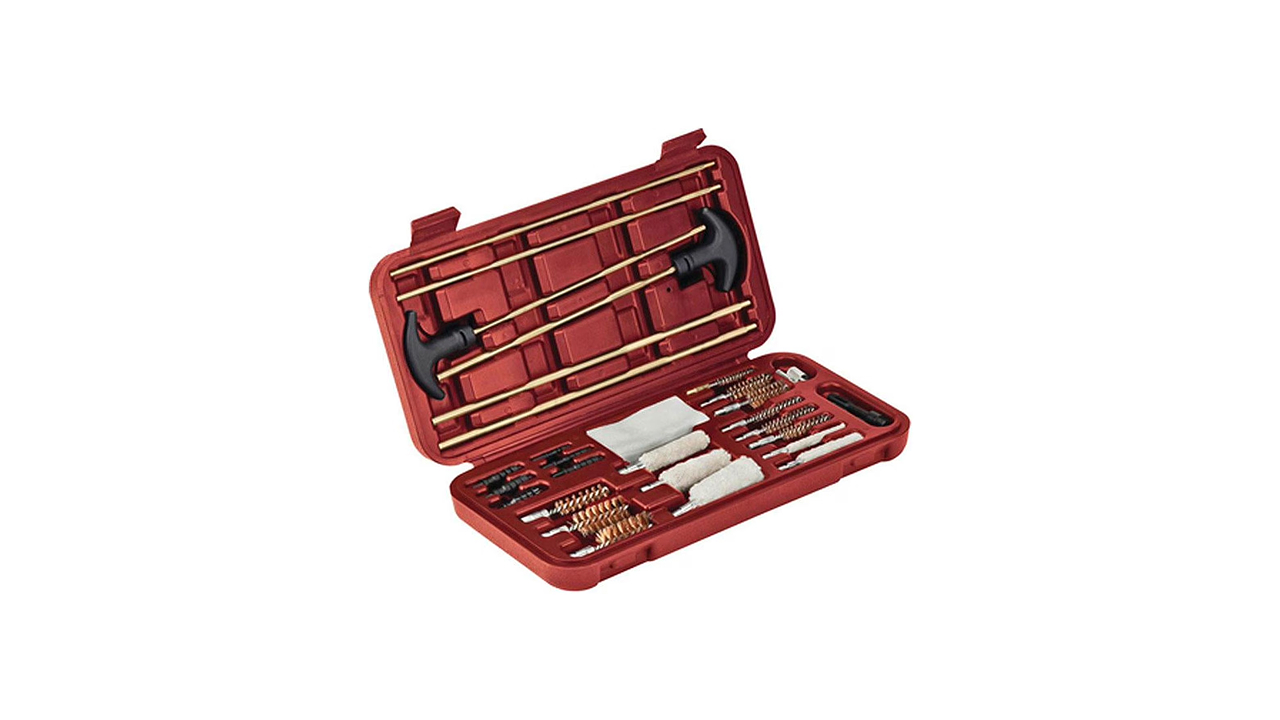
One of the biggest challenges for new gun owners who purchase a cleaning kit is the lack of a clear instruction manual. Most kits simply list the included parts without explaining what they do or how to actually clean the firearm.
In this guide, we break down every component found in a standard pistol cleaning kit and explain how to clean a gun safely and correctly, step-by-step. While we reference the Sig Sauer P365 as an example, these methods apply generally to almost all semi-automatic pistols.
Understand cleaning kit components
A standard gun cleaning kit usually contains specific tools designed for different stages of the process. Here is what they are and how to use them:
Cleaning rod
This rod often comes in sections that screw together, allowing it to fit into compact kit boxes. The tip of the rod usually swivels freely; this allows attached brushes to rotate and follow the rifling inside the barrel without unscrewing or damaging the grooves.
Bore brushes
These wire brushes come in specific sizes to match your gun’s caliber. They are used to physically scrub out gunpowder residue and carbon buildup from inside the barrel. Choosing the correct caliber size is essential for effective cleaning.
Patch holders and jags
These attachments hold the cleaning patches that you push through the barrel.
- Patch holder: Has a large slot (like a needle eye). It allows you to move the patch back and forth inside the barrel.
- Jag: A pointed attachment that holds the patch tight against the barrel walls. It is generally used for one-way cleaning (pushing dirt out the front).
Mop
This looks like a soft cotton swab. It is used to apply oil or solvent to the inside of the barrel. However, since mops get dirty quickly, many users prefer using disposable patches instead.
Cleaning oil (CLP)
CLP stands for Clean, Lubricate, and Protect. It is an all-in-one solution that dissolves grime, lubricates moving parts, and protects metal surfaces from rust.
Cleaning patches
These are small, square cotton cloths. They are used to wipe the inside of the barrel clean and remove excess oil.
Gather extra household items
In addition to your professional kit, a few common household items make the job much easier:
- Cotton rags or cut-up old t-shirts.
- Q-tips (cotton swabs), preferably those with pointed tips for tight corners.
- Toothbrush or a double-ended nylon brush.
These items are particularly effective for reaching tight spaces inside the slide and on the frame.
Ensure safety first
Before you touch a cleaning tool, you must guarantee the weapon is completely empty.
- Remove the magazine.
- Check the chamber visually and physically.
- Repeat these checks to be certain.
Once clear, field strip the weapon according to the manufacturer’s instructions. Most semi-automatic pistols separate into four main groups: the slide, barrel, recoil spring, and frame.
Clean barrel and feed ramp
The barrel is the most critical and usually the dirtiest part of the gun. You need to focus on two areas: the bore (inside) and the feed ramp.
- Apply CLP: You can drip oil directly into the bore, run an oil-soaked patch through it, or use a mop.
- Wait: Let the oil sit for a few minutes to break down the carbon.
- Scrub: Attach the bore brush to the rod and push it back and forth through the barrel to loosen debris.
- Wipe: Switch to a patch holder or jag. Run dry patches through the barrel until they come out clean.
Finally, lightly oil and wipe the feed ramp and the exterior of the barrel. This cleans the surface and prevents rust.
Scrub slide and frame
Once the barrel is done, move to the slide and frame.
- Lightly oil the slide rails and any surface with carbon buildup.
- Scrub these areas with your nylon brush or toothbrush.
Critical Warning: Do not drip oil into the firing pin (striker) channel or the small hole where the firing pin protrudes. Oil in this area can collect dust and turn into a sludge that causes light primer strikes. Keep this area dry.
Use Q-tips and rags to wipe down hard-to-reach areas. The recoil spring usually stays relatively clean, but you can brush off any visible debris.
Lubricate and reassemble
After everything is clean and wiped dry, apply a very small amount of fresh oil. For most semi-automatics:
- Place one drop on each rail guide.
- Apply a very thin film of oil to the barrel exterior.
Avoid over-lubrication, as excess oil acts like a magnet for dirt and lint. Reassemble the firearm and rack the slide a few times to distribute the oil evenly. Finally, wipe down the exterior with a dry cloth.
Use bore snake for speed
If you want a faster method, consider using a Bore Snake. This is a rope-like tool specifically designed for your caliber. It has built-in brushes and a thick floss area.
It works by:
- Loosening debris with embedded bronze brushes.
- Wiping the barrel with the tail section in a single pull.
While a traditional rod and patch are better for deep cleaning, a Bore Snake is excellent for quick maintenance between range sessions.